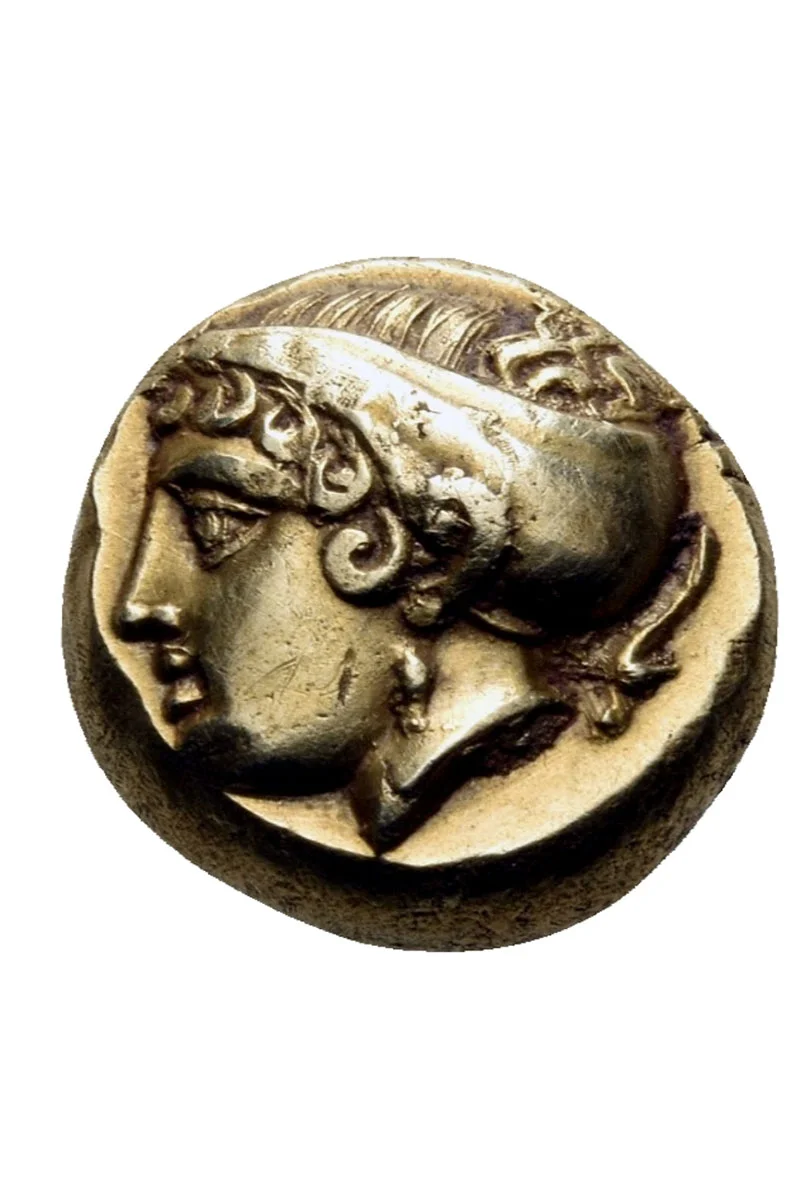
Struck in Phokaia on the coast of Ionia around 478–387 BC, this small electrum hekte carries an image of remarkable refinement. A female head appears in profile, her hair contained beneath a sakkos, a pendant earring at her ear. Behind her, almost hidden at first glance, a tiny seal swims downwards.
Her identity remains elusive. The elegant female head has sometimes been associated with the nymph of Phokaia, yet the coin offers no attribute that allows her to be named with certainty. The little seal, however, leaves no doubt about where she belongs. It was the emblem of Phokaia, its presence playing upon the Greek phōkē, meaning seal.

It is an eloquent symbol for a city whose history was shaped by the sea. The Phokaians were among the great navigators of the ancient Mediterranean, travelling far beyond the Ionian coast and establishing settlements and trading communities across its western reaches, most famously Massalia, present-day Marseille.

At only 10 mm, the coin belongs to a world in which an astonishing amount of meaning could be compressed into the smallest object. Struck in electrum, the natural alloy of gold and silver characteristic of early Ionian coinage, it has survived for some 2,400 years with the delicacy of the profile and its minute marine emblem still beautifully legible.
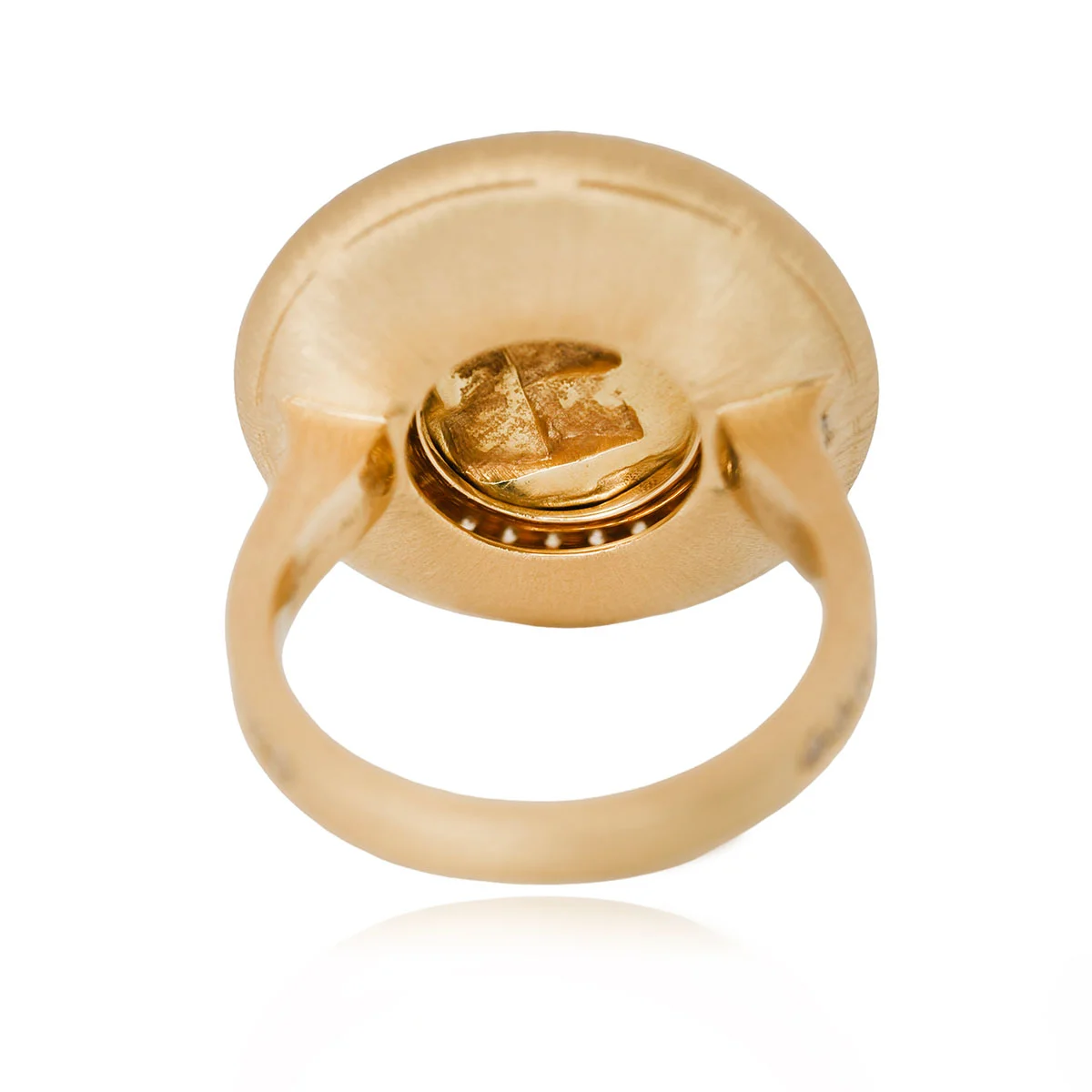
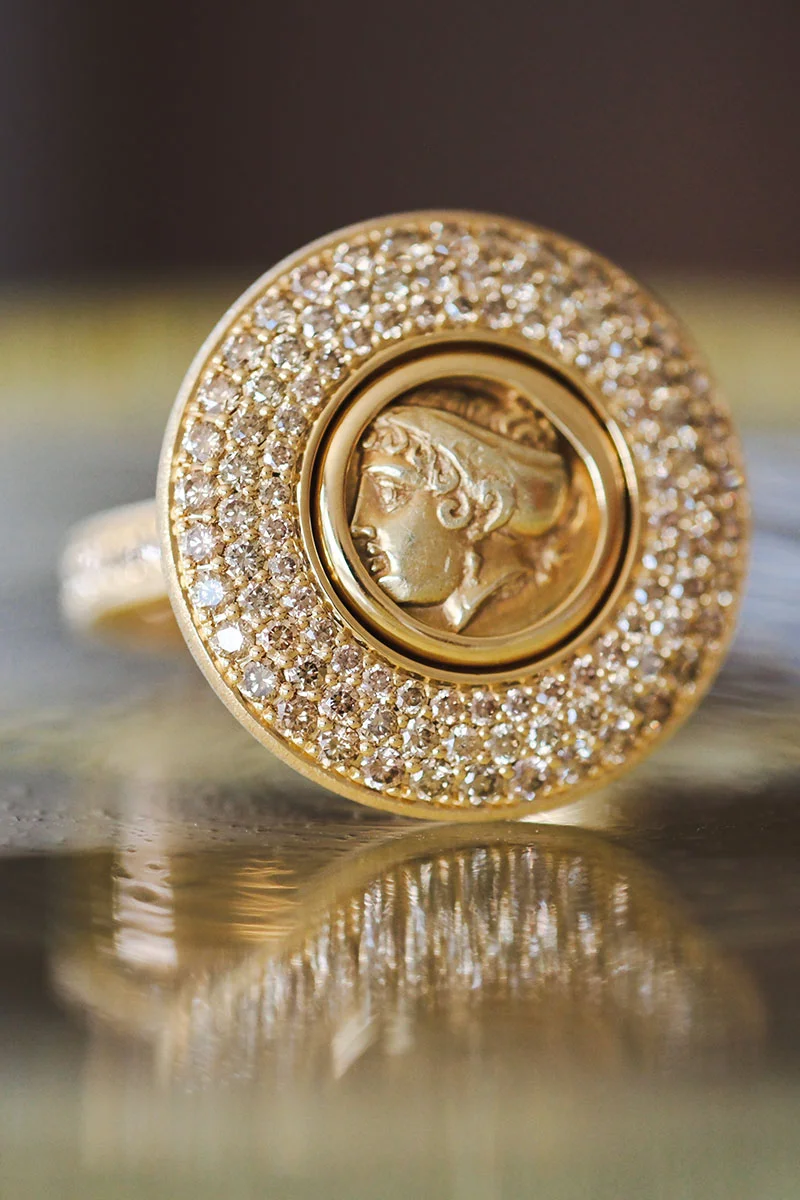
For the Phokaia Ring, the ancient coin is set within a broad disc of satin-finished 18-carat yellow gold, surrounded by 122 champagne diamonds. Their muted warmth creates a soft field of light around the electrum, allowing the ancient image to remain the focus. As with every Tanit jewel, the coin itself remains intact.

The Phokaia Ring has now found its custodian: a woman who has lived in many places and spent much of her adult life travelling. Few ancient cities could offer a more fitting provenance. Herodotus remembered the Phokaians as the first Greeks to undertake long sea voyages. From their two harbours on the Ionian coast, they ventured westwards across the Mediterranean, founding communities from Massalia, present-day Marseille, to Emporion in Spain and Elea in southern Italy. Movement across borders and cultures belonged to the history of Phokaia. Some 2,400 years later, its tiny electrum coin continues that journey with a woman whose own life has unfolded across countries and continents.