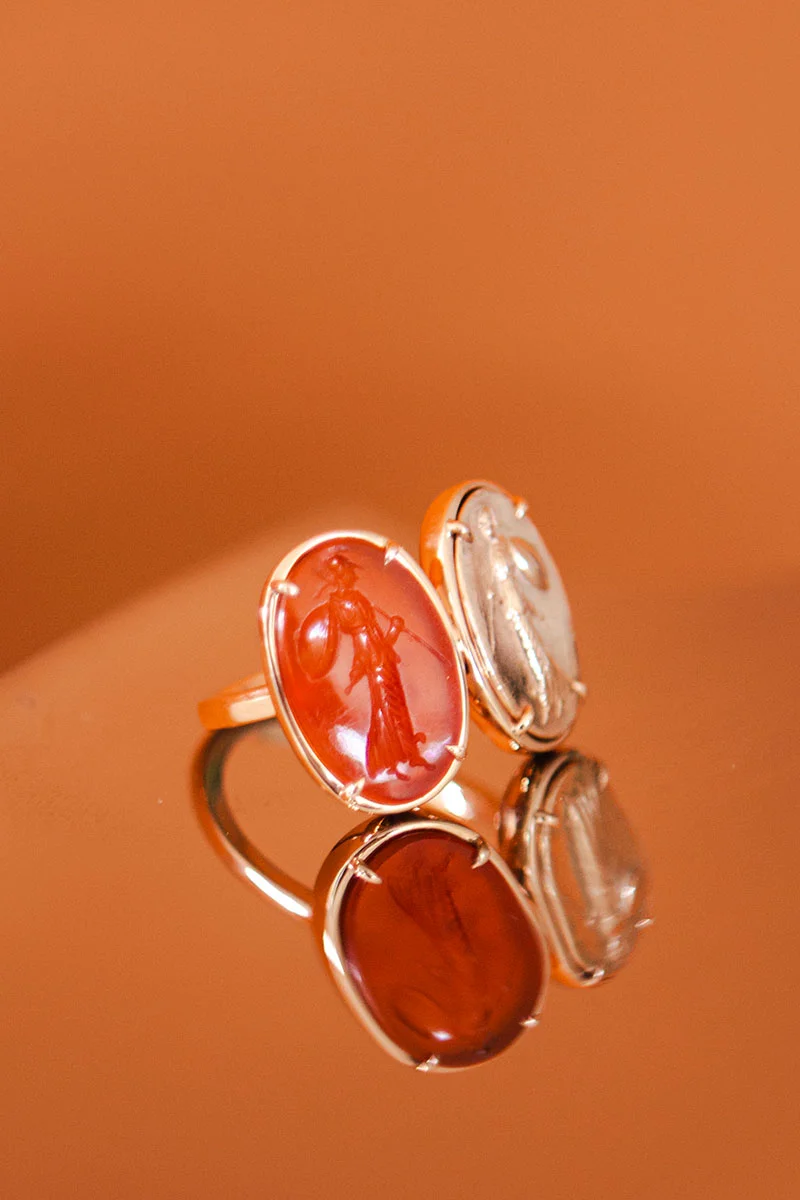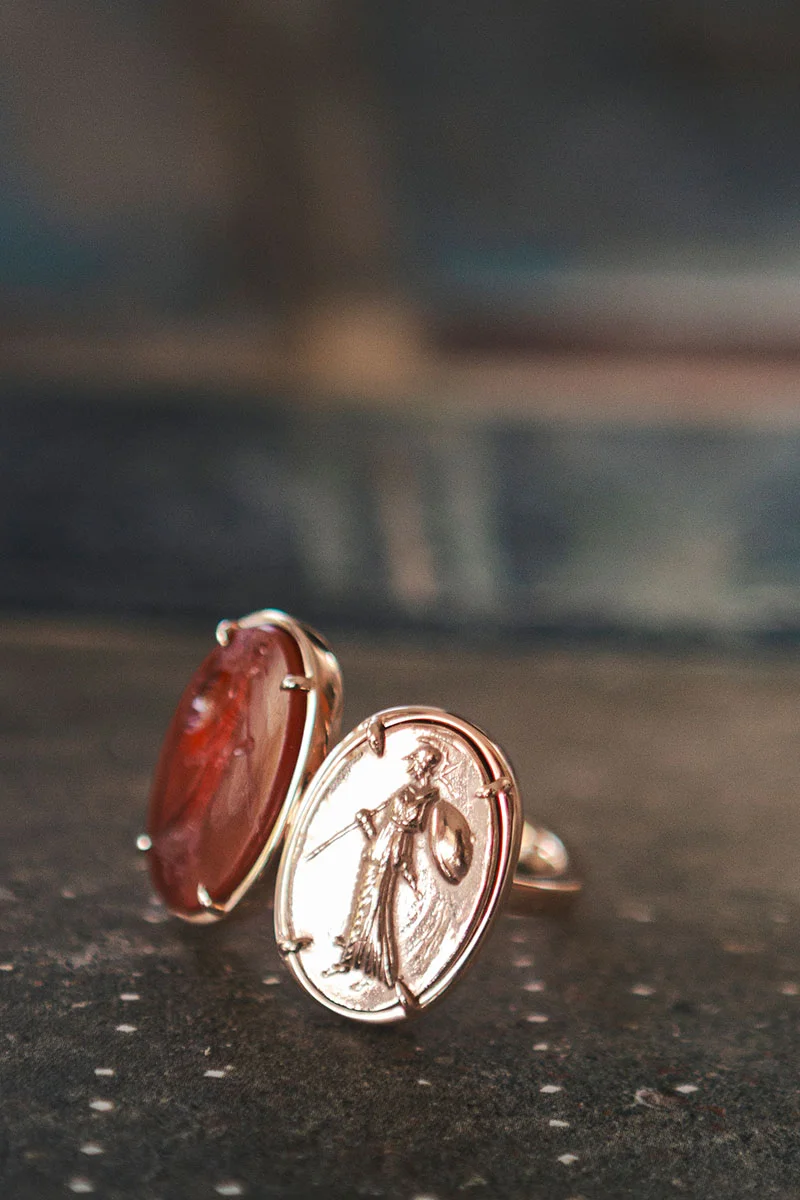

This exceptional Roman intaglio in carnelian, carved in the 1st–2nd century CE, when glyptic art flourished in Rome, depicts Minerva. She stands facing left, wearing a crested helmet and holding a spear and shield. Not surprisingly, the auction house catalogued her as Athena, the Greek goddess of wisdom and strategic warfare. The Romans, however, adopted her image and attributes in the figure of Minerva.
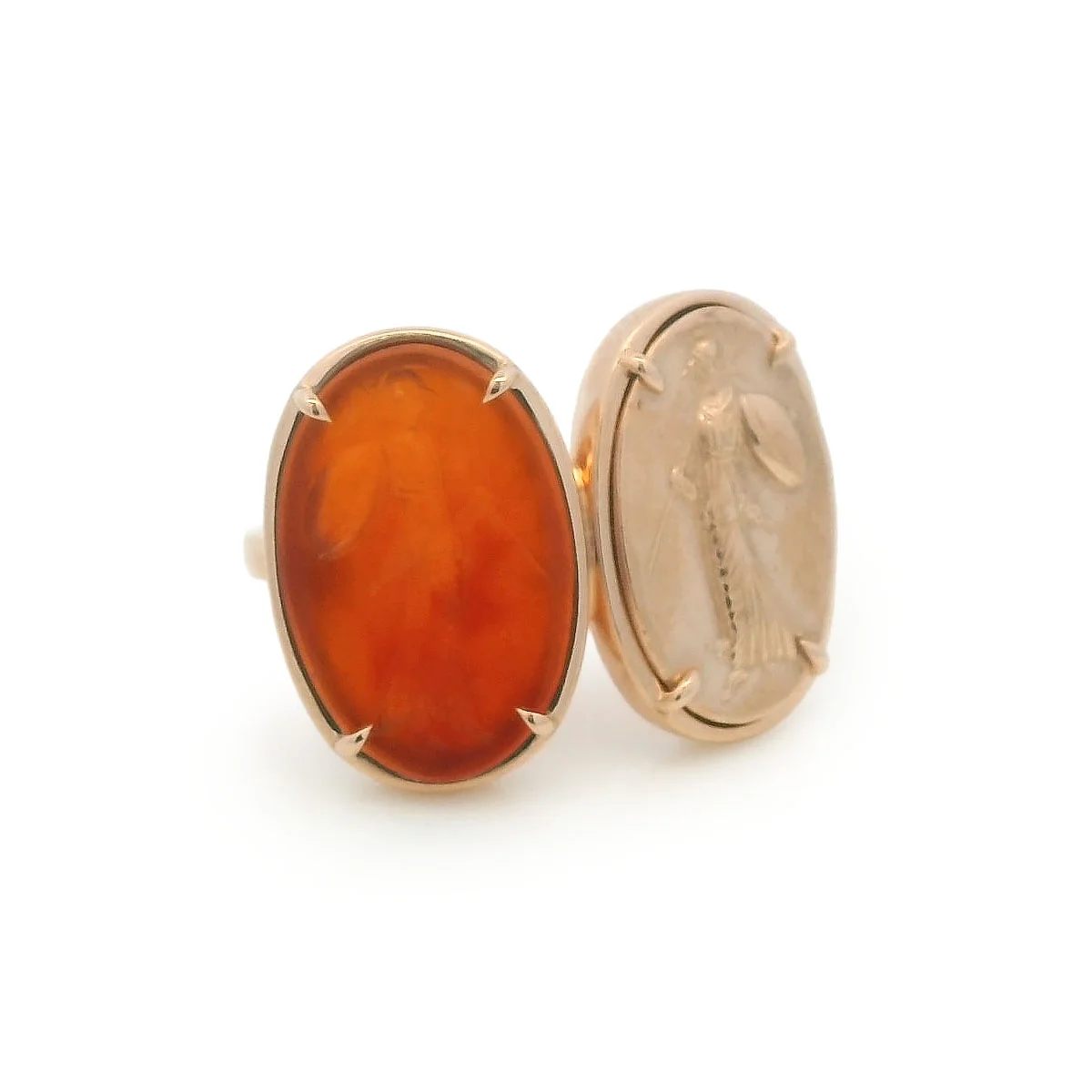
The distinction of the intaglio lies in the quality of the gemstone and its engraving. Measuring 17 × 11 × 3 mm, the stone has an intense orange-red colour and exceptional translucency. The goddess’s body remains visible beneath her long drapery; the folds of the fabric, her crested helmet, the rounded shield and the fine line of the spear are all precisely defined within the small surface of the stone.
More modest Roman intaglios were often more summarily cut, their figures reduced to a sequence of readily legible lines. In contrast, the carving here is deep, detailed and sculptural. The engraver worked beyond the requirements of a functional seal, creating an image that could also be appreciated directly in the stone. The quality of the carnelian and the refinement of the carving suggest an important object, possibly made as a private commission or selected from the work of a highly accomplished engraver.
Intaglios functioned as personal signatures. Pressed into wax or clay to seal correspondence and agreements, they carried images chosen to represent the identity and values of their owners. Minerva was associated with clear thought, skilled workmanship and strategic intelligence. Unlike Mars, whose sphere was the physical force of war, Minerva represented discipline, foresight and the considered use of power.
To reveal the quality of the image, we pressed the intaglio into wax. Through the lost-wax technique, this impression was then cast in 18k rose gold, making visible in gold the exact form the intaglio was originally created to produce almost two thousand years ago.
The gold impression is set opposite the carnelian. The two images of the goddess turn towards one another, as though Minerva sees herself in a mirror. The design follows the oval of the ancient gem and recalls the intimacy of Roman signet rings, in which the engraved stone sat close to the hand. The rose-gold setting protects the carnelian while allowing light to pass through it, revealing the depth of the engraving and the exceptional colour of the stone.
Uniting an artefact carved almost two thousand years ago with its impression in gold, the ring returns the intaglio to a living context. It preserves not only the image of Minerva, but also the purpose for which it was made: to pass from stone into impression and to leave a personal sign in wax, clay and memory.
Today, the ring’s custodian is a woman whose work as an international lawyer calls for clarity of thought, foresight and considered judgement. Minerva, whose strength lies not in force but in intelligence and strategy, becomes a fitting emblem for her. The ancient seal once carried the values of its Roman owner into matters of consequence; almost two thousand years later, it accompanies a woman whose own authority is grounded in knowledge, discernment and the precise use of words.