The Price of Scarcity
In July 2026, De Beers announced a two-year suspension of production at the Venetia mine in South Africa. The mine is not exhausted. As the country’s largest producer, it had recently received billions of dollars in investment. Yet weakening demand and excess supply prompted the decision: rough diamond prices had fallen by 50 per cent since 2022. Diamond analyst Paul Zimnisky offered a curious assessment. Retailers were unlikely to feel these production cuts immediately because miners and wholesalers still held excess inventory. Yet if the cuts continued, shortages could emerge by 2027. An industry burdened by surplus stock was already speaking the language of future scarcity. The diamonds had not become rarer in the ground; their flow to market was simply being choked.
To understand how abundance and scarcity became so strangely entangled in the diamond trade, we need to return to the nineteenth century, when the discovery of immense deposits in South Africa confronted the industry with a problem it has never entirely escaped.
The Earth Opens
By the early nineteenth century, Brazilian riverbeds were running dry, briefly restoring genuine geological scarcity to the diamond market. That scarcity proved illusory.
In 1867, a stone found near the Orange River in South Africa was identified as a diamond. Prospectors rushed to the region, initially uncovering loose stones in river gravels. The true shock came when they discovered the source: diamonds embedded in massive volcanic pipes. These were not isolated geological curiosities, but industrial-scale subterranean deposits.
South African exports surged from a few hundred carats in 1867 to an annual output of nearly four million carats by 1888. Within two decades, South Africa had produced more diamonds than India was estimated to have yielded over three millennia. Indian diamonds had been genuinely rare for centuries. The eighteenth-century arrival of Brazilian stones had already encouraged silver-set ornaments where diamonds appeared in profusion across European courts. Yet this display still relied upon the belief that the gemstone was inherently valuable. South Africa shattered that belief.
Once diamonds could be extracted in industrial quantities, abundance threatened to make them ordinary, hardly different from rock crystal or glass. Scarcity could no longer be treated as a fact of nature. It had to be manufactured, protected and ferociously defended.
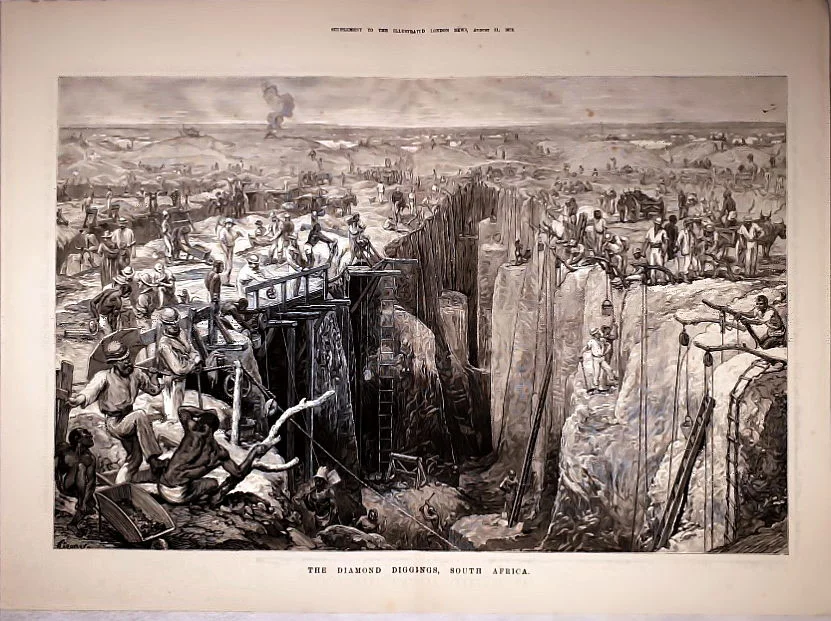
The Diamond Diggings, South Africa. Félix Élie Régamey, 1872. Woodcut published in the Illustrated London News, 31 August 1872.
The Danger of Abundance
The scale of the South African finds created an immediate commercial threat: unregulated extraction would collapse wholesale prices and destroy the gemstone’s prestige.
The early years of the diggings were marked by a chaotic frenzy of competition among thousands of small claimholders. Each digger acted rationally by extracting as much as possible, but collectively they were flooding the market. The financiers who gradually bought out these claims confronted a brutal paradox: every additional diamond extracted weakened the value of those already on the market. Geological success threatened commercial failure. Extraction had to yield to control.
The Architecture of Monopoly
As excavations deepened, mining demanded expensive machinery and organised labour. Falling rough prices trapped small diggers between rising costs and diminishing returns. Financiers acquired these failing claims at depressed prices, replacing the independent prospector with industrial capital.
By 1888, Cecil Rhodes and Barney Barnato were the principal rivals for control of the Kimberley diggings. Backed by N. M. Rothschild & Sons, Rhodes acquired Barnato’s Kimberley Central Mining Company to form De Beers Consolidated Mines. By the turn of the twentieth century, De Beers controlled approximately ninety per cent of global rough-diamond production.
This monopoly gave De Beers unprecedented power over supply. The company could influence how many diamonds were extracted, how much production from mines beyond its own entered its system, how many stones reached the market, who was permitted to buy them and at what price the rough was sold.
The Machinery of Scarcity
De Beers preserved the illusion of scarcity through four primary mechanisms.
- Controlling External Supply
When important deposits were discovered in Namibia, Botswana, the Soviet Union and later Australia, De Beers negotiated purchasing agreements that channelled global output through its own distribution network. - Stockpiling
Rough diamonds were routinely held in company vaults during periods of sluggish demand. Supply was systematically decoupled from mining volume. - The Sightholder System
Selected dealers were invited to purchase pre-assorted parcels of rough diamonds on a non-negotiable, take-it-or-leave-it basis, securing De Beers’ distribution control. - Administrative Pricing
Wholesale prices were not dictated by the open market but set by De Beers.
The Diamond on the Crown
The rise of De Beers was intertwined with British imperial expansion. Cecil Rhodes combined corporate governance with political power as Prime Minister of the Cape Colony. Meanwhile, the British court provided the diamond with its most prominent stage and endowed it with extraordinary prestige.
Under Queen Victoria, British imperial dominance made its court a visual model across Europe and beyond. Royal jewellery established the visual language of rank. Diamonds worn in crowns, tiaras, and brooches transformed colourless brilliance into a public sign of authority. What appeared at court was swiftly adopted by aristocratic elites and coveted by the emerging middle classes.
International exhibitions, illustrated journals, and early photography broadcast these imperial codes to global audiences. Queen Victoria played a particularly powerful role within this system. She acted as an arbiter of jewellery fashion: what she wore influenced what her subjects wore. Royal patronage also intersected with commerce. Victoria consciously supported British companies, giving the jewellery choices of the court direct economic consequences.
A Different Language of Power
The scale of this transformation becomes clearer when we look back nearly three centuries. In 1602, the Antwerp goldsmith Jan Vermeyen created the Rudolfskrone (the crown of Emperor Rudolf II) in Prague.
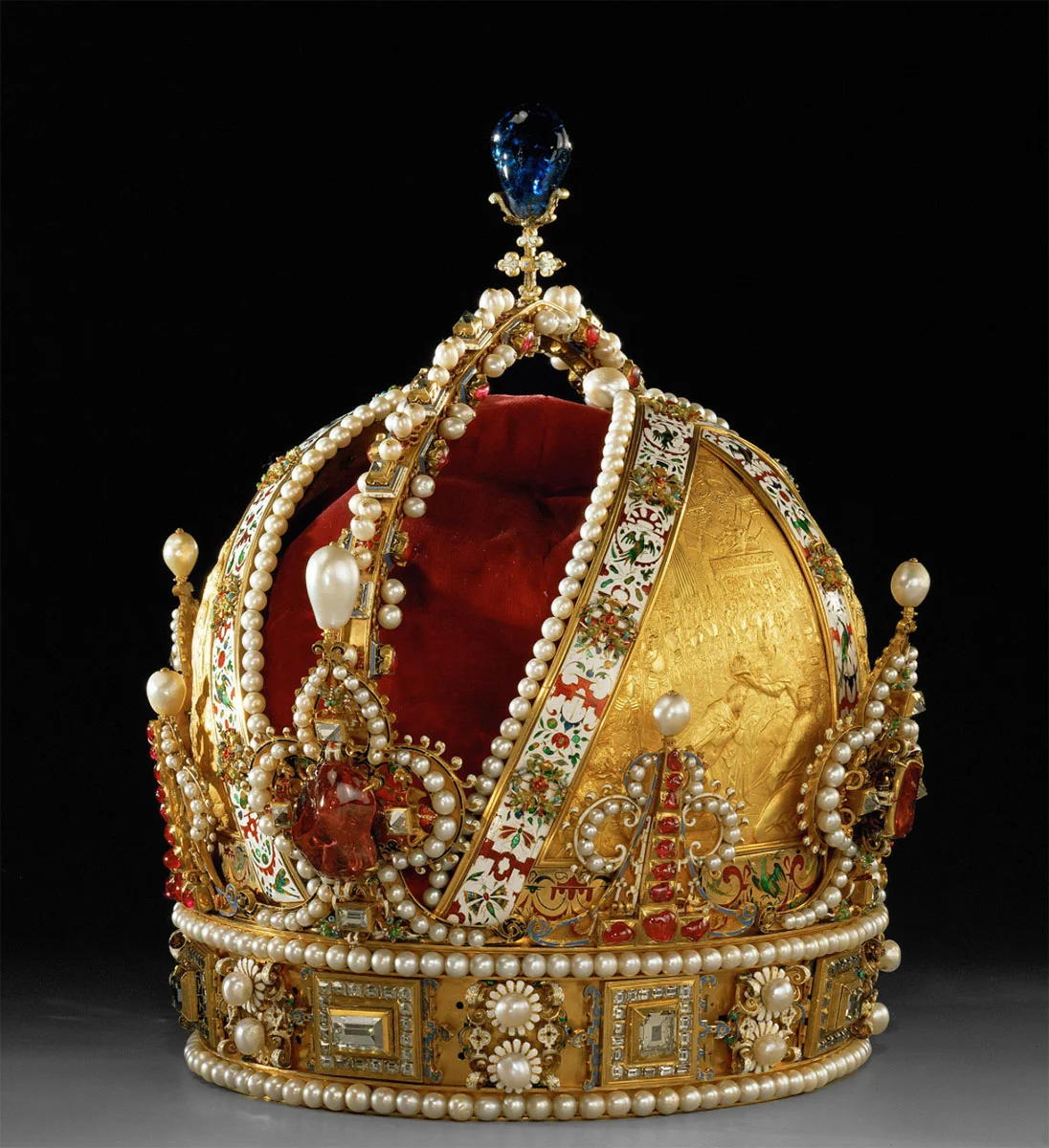
The Rudolfskrone, created by Jan Vermeyen for Emperor Rudolf II in 1602.
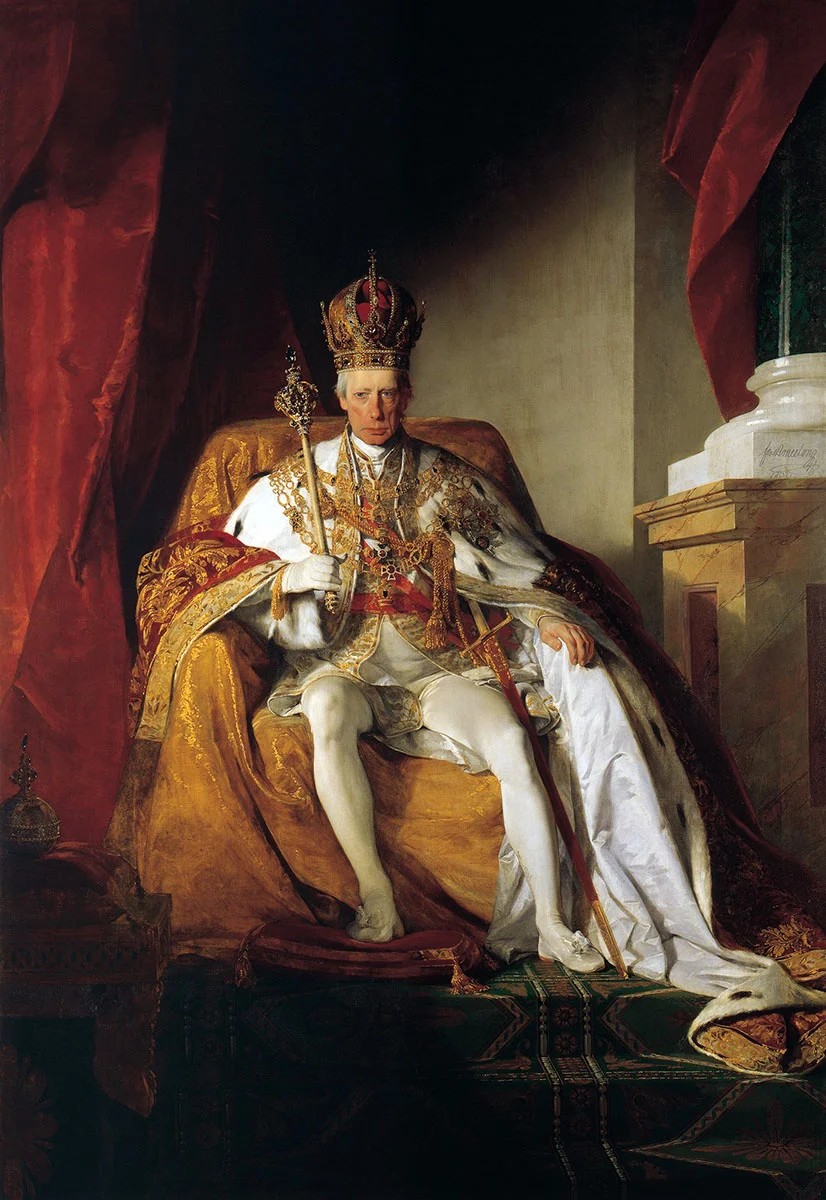
Portrait of Emperor Francis I of Austria by Friedrich von Amerling (1832), showing the Imperial Crown of Austria, Sceptre, and Regalia.
Few objects reveal such harmony between artistic conception and political iconography. The reliefs on the mitre present Rudolf II as Holy Roman Emperor, King of Hungary, King of Bohemia, and victorious ruler. Its design balances gold, spinels, sapphires and pearls with enamel. No single material dominates; every component contributes to a coherent symbolic language.
Adopted in 1804 as the official crown of the Austrian Empire, the Rudolfskrone continued to express sovereignty through colour, goldsmithing, and iconography well into the nineteenth century. Its power resided in the artistic synthesis of the whole, not in the multiplication of a single gemstone.
The Monochrome Mandate
Contrast this with Queen Victoria’s Small Diamond Crown, created in 1870 by R. & S. Garrard & Co. Densely set with 1,187 brilliant- and rose-cut diamonds, it contains neither coloured gemstones nor visible gold. Its openwork framework was constructed entirely of silver. Commissioned to be worn atop Victoria’s white lace widow’s cap against black mourning dress, the crown reduced royal splendour to a relentless, colourless brilliance. Where the Rudolfskrone had united warm gold, saturated gemstones, and polychrome enamel, Victoria’s crown offered only monochromatic sparkle. Silver served as mere scaffolding; diamonds became the entire aesthetic proposition.
European goldsmithing did not abandon gold entirely. The Victorian era remained rich in yellow gold and coloured gemstones for daytime wear. Flashing diamonds before dusk was considered vulgar. The displacement occurred strictly at the summit of formal evening wear, state banquets and court presentations. There, colourless stones set in cold silver or platinum increasingly pushed gold and coloured gemstones into the background. As royal imagery circulated through official state portraits, stamps, coinage and press photography capturing these grand occasions, this monochrome aesthetic was broadcast globally as the absolute pinnacle of wealth and power. The rise of photography and film further favoured this aesthetic. In black-and-white, gold and coloured gemstones were stripped of their most important distinction: colour.
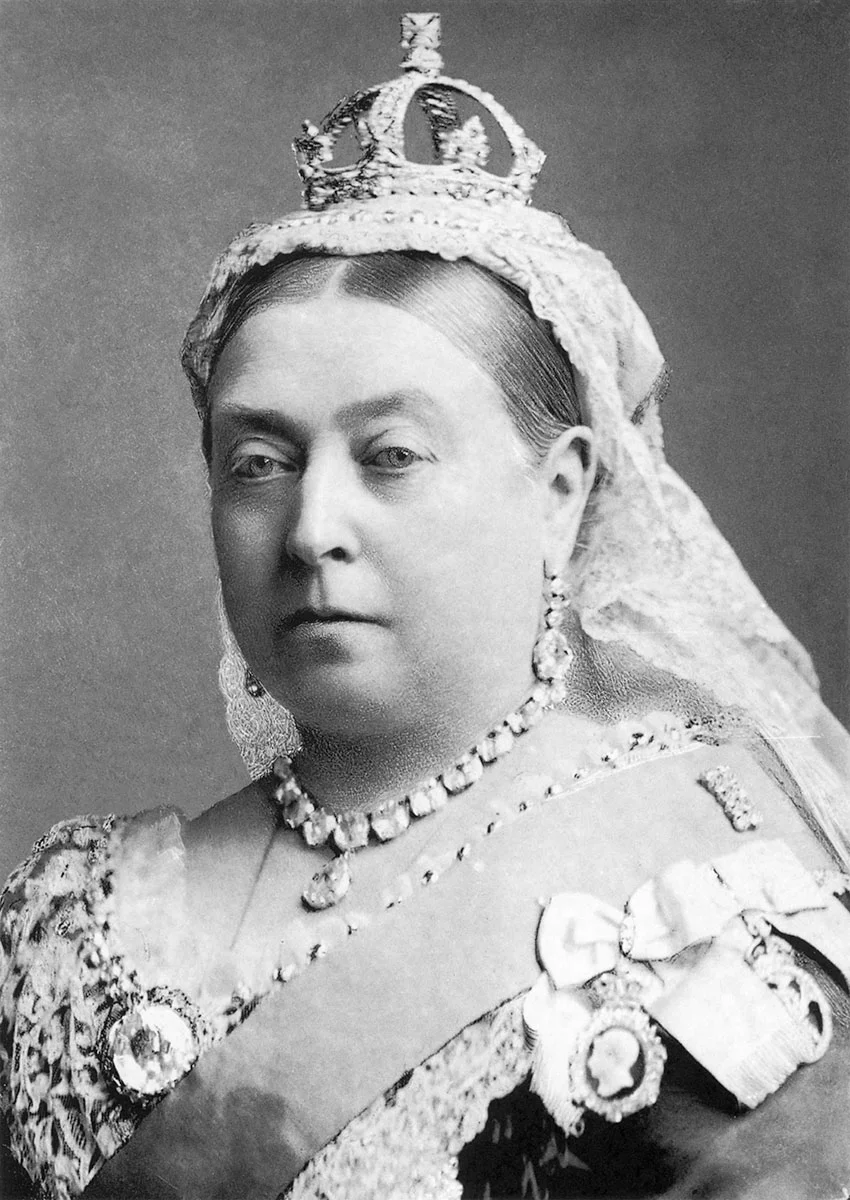
Queen Victoria wearing her Small Diamond Crown, photographed by Alexander Bassano. The crown measures just 9.9 cm in height, yet is set with 1,187 diamonds.
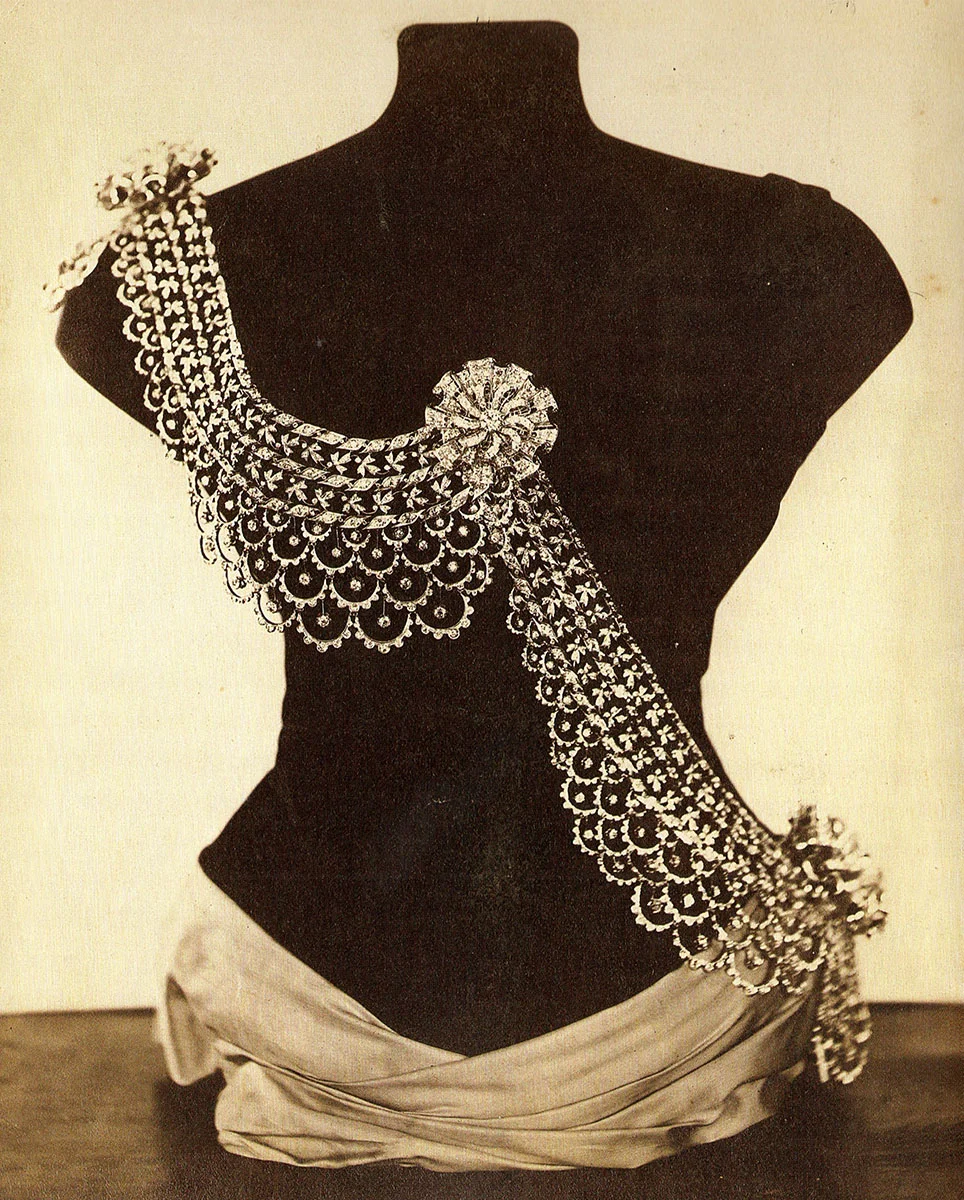
Diamond lace bertha, Tiffany & Co., exhibited at the Paris Exposition Universelle, 1889. Measuring approximately 90 centimetres and composed of some 2,200 diamonds. Photograph: Tiffany & Co. Archives; reproduced in Charlotte Gere and Judy Rudoe, Jewellery in the Age of Queen Victoria: A Mirror to the World (British Museum Press, 2010).
This preference was not invented by the British court. As explored in our previous essay, But… Where Is the Gold?, it emerged already under Louis XV as Brazilian diamonds arrived in quantity, continuing through Napoleon and nineteenth-century European court dress. However, the British court gave this colourless aesthetic its ultimate global authority, scaling and democratising a visual code that effectively silenced the rich chromatic traditions of Western goldsmithing at the highest levels of display. The proliferation of diamonds in late nineteenth-century royal jewellery proved strategically advantageous, intentionally or not. Just as South African mines were transforming the diamond into an abundant commodity, the British court flaunted it with maximum visibility.
The Tiara as Symbol
The tiara proved to be the ideal vehicle. Revived from the diadems of ancient Greece during the French Empire, the tiara became an essential element of female imperial court dress. By the 1870s, as South African diamonds flooded the market, the tiara reached the peak of its popularity. It offered a framework capable of carrying hundreds and even thousands of diamonds. As newly wealthy families entered the titled elite, the tiara also became one of the clearest outward signs of social arrival.
Raised above the brow, a tiara was legible across a crowded ballroom. Under candlelight and gaslight, diamonds responded to every movement, casting the wearer in reflected light. In black-and-white portraiture, the diamond tiara lost little of its visual impact. Its image travelled onto coins, stamps and prints, permanently linking white brilliance with royal authority.
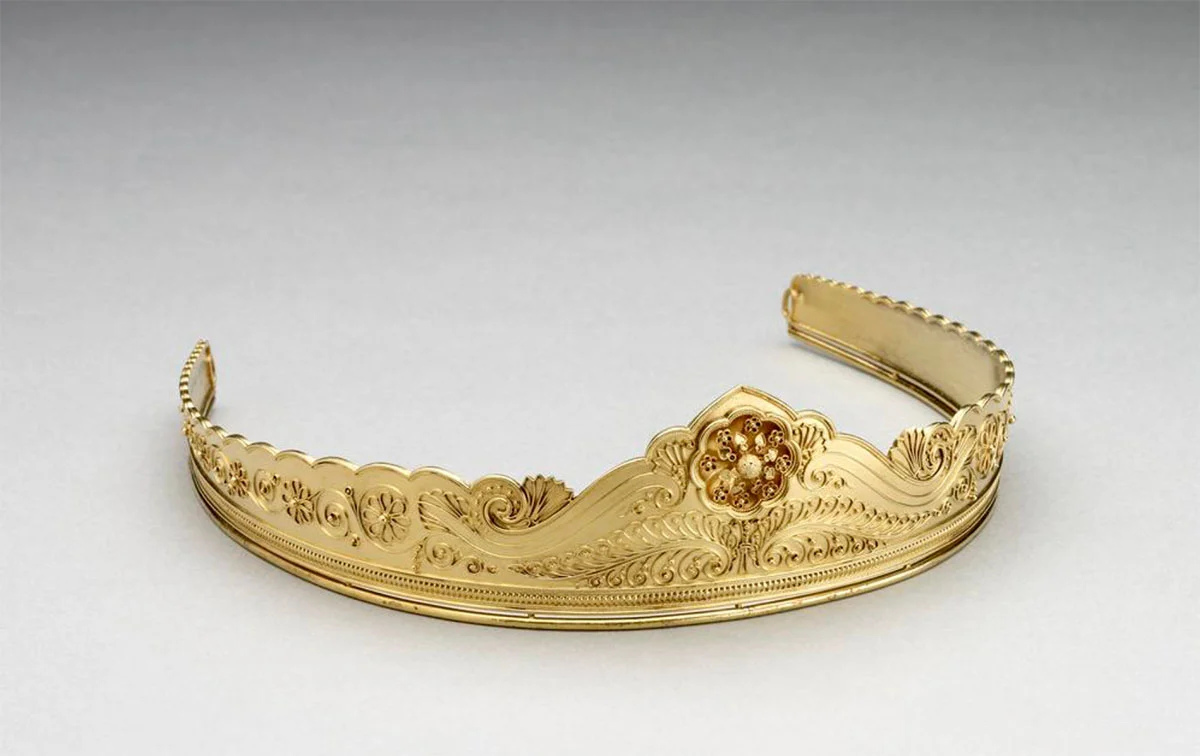
Gold diadem by the firm of Josef Bacher, Vienna, c. 1878–80. British Museum, Hull Grundy Gift (1978,1002.1122). © The Trustees of the British Museum. Shared under a Creative Commons Attribution-NonCommercial-ShareAlike 4.0 International (CC BY-NC-SA 4.0) licence.
When Royalty Is No Longer Enough
Court culture had bestowed diamonds with the prestige of rarity. South Africa changed the geological reality almost overnight, but the old association between rarity and prestige survived. That contradiction now had to be protected at all costs.
At the same time, the nineteenth century created unprecedented opportunities to spread that prestige far beyond the courts. Industrialisation generated new fortunes and greatly expanded the jewellery market. International exhibitions brought the jewels of courts and leading makers before enormous audiences, while improved transport encouraged travel and international commerce. Postal services enabled jewellers to maintain distant clients and even send jewellery directly to them. Newspapers, illustrated publications and, increasingly, photography carried the appearance of royal and fashionable women far beyond the circles in which they moved. Jewellery could now be seen, desired, ordered and imitated on a scale earlier generations could scarcely have imagined.
The diamond trade therefore entered the age of South African production with an expanding market already in place. Royalty remained at the summit, aristocratic and newly wealthy elites followed its example, and the visual codes of rank travelled progressively further through society. Yet even this rapidly growing appetite could not indefinitely absorb nearly four million carats a year pouring from the South African mines without threatening the very prestige that made diamonds valuable.
De Beers faced a peculiar challenge. The market had to keep expanding, but diamonds could never be permitted to become ordinary. Monopoly and stockpiling could restrict supply and sustain the appearance of scarcity, yet industrial-scale production ultimately required an equally extraordinary expansion of demand. The symbolism of rarity had to reach an ever larger public without losing its association with privilege. Diamonds had to become objects of universal desire.
In our third and final essay, The Cost of Forever, we shall examine how this final illusion was built.