A Byzantine gold ring dating from the twelfth or thirteenth century provided the starting point for Zeste. Its construction caught our attention: a square setting held by four pronounced claws, surrounded by delicate granulation. The ring belongs to a much longer tradition of working gold, in which forms and techniques travelled across cultures and centuries.

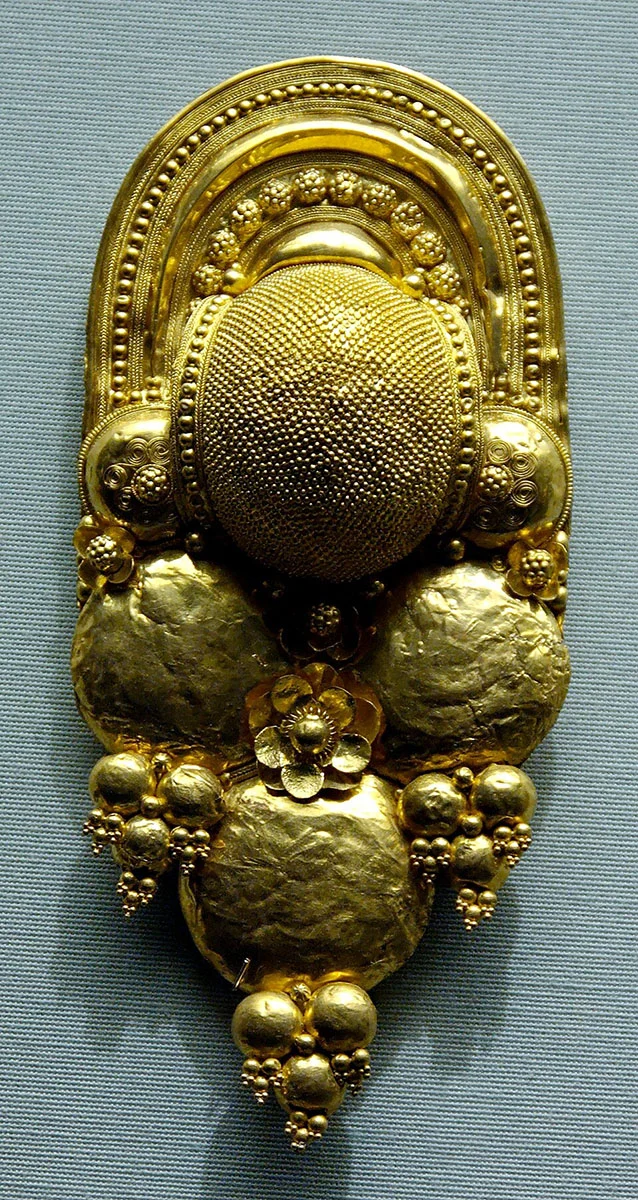
Granulation itself was already ancient. The technique of applying minute spheres of gold to a surface had reached extraordinary refinement long before the Byzantine period, particularly in the work of Greek and Etruscan goldsmiths. Byzantine craftsmen inherited this technical vocabulary and continued to use tiny gold granules to articulate surfaces and settings. In the medieval ring, these small spheres of gold soften the geometry of the setting. It was a detail we wanted to retain.
“The Byzantine ring immediately appealed to me because of the contrast between its strong geometry and the delicacy of the little gold granules. During my coloured gemstone studies at IGI, I had been fascinated by the buff-top cut. For Zeste it seemed exactly right: the clean, smooth surface of a cabochon above, with the light and movement of a faceted stone beneath.”
Renilde Vervoort
For Zeste, the square form was retained but refined. A line of tiny gold spheres surrounds the gemstone, subtly recalling the granulation of the medieval ring without reproducing it.
The choice of gemstone cut became equally important. A buff-top combines two apparently contradictory treatments. Its upper surface is smooth and polished like a cabochon, while its pavilion is faceted. Light enters through the smooth surface and meets the facets below, bringing brilliance and movement to a stone that remains calm and uninterrupted from above.

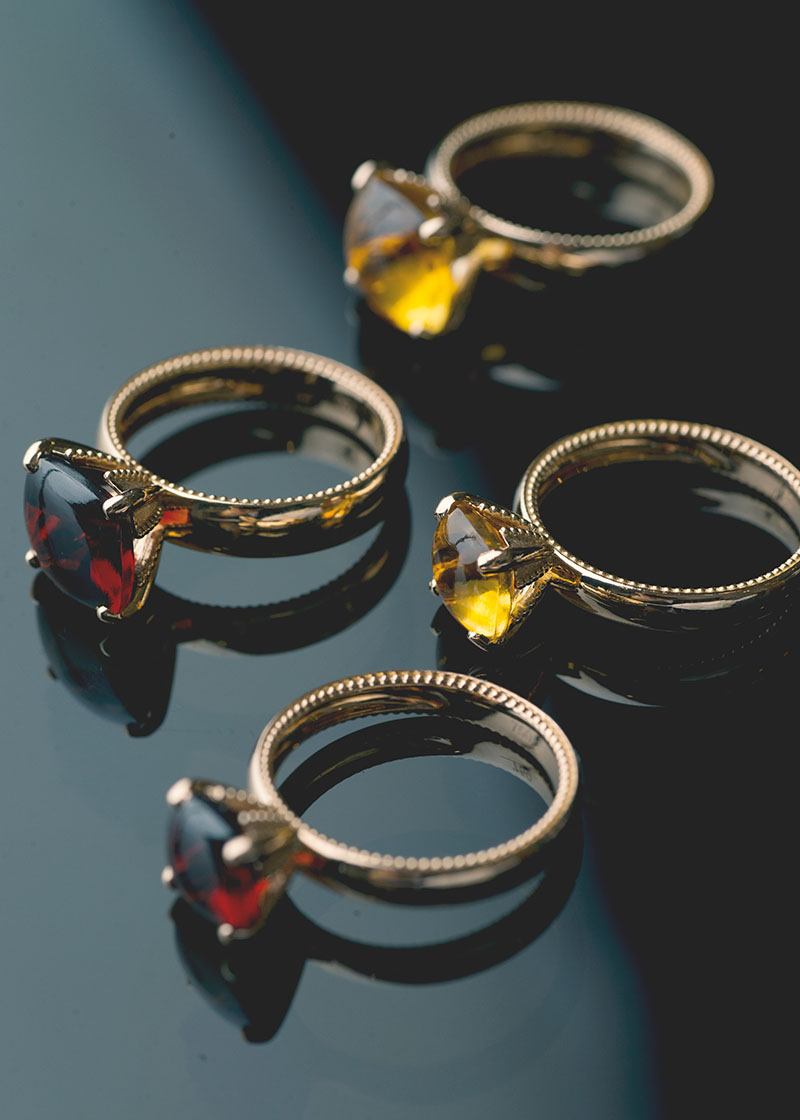
Peridot and garnet joined two different shades of citrine in a palette borrowed from citrus fruit: lime, lemon, tangerine and blood orange. The colours gave the collection its name, Zeste.
The gemstones were cut in two sizes, 8 and 10 millimetres. Rings were made with a single stone or with two gemstones placed together, allowing different colours and proportions to be combined.
Worn alone, each ring is a concentrated point of colour. Placed together, the different stones, sizes and citrus shades create changing combinations.